
A Thousand Harvests
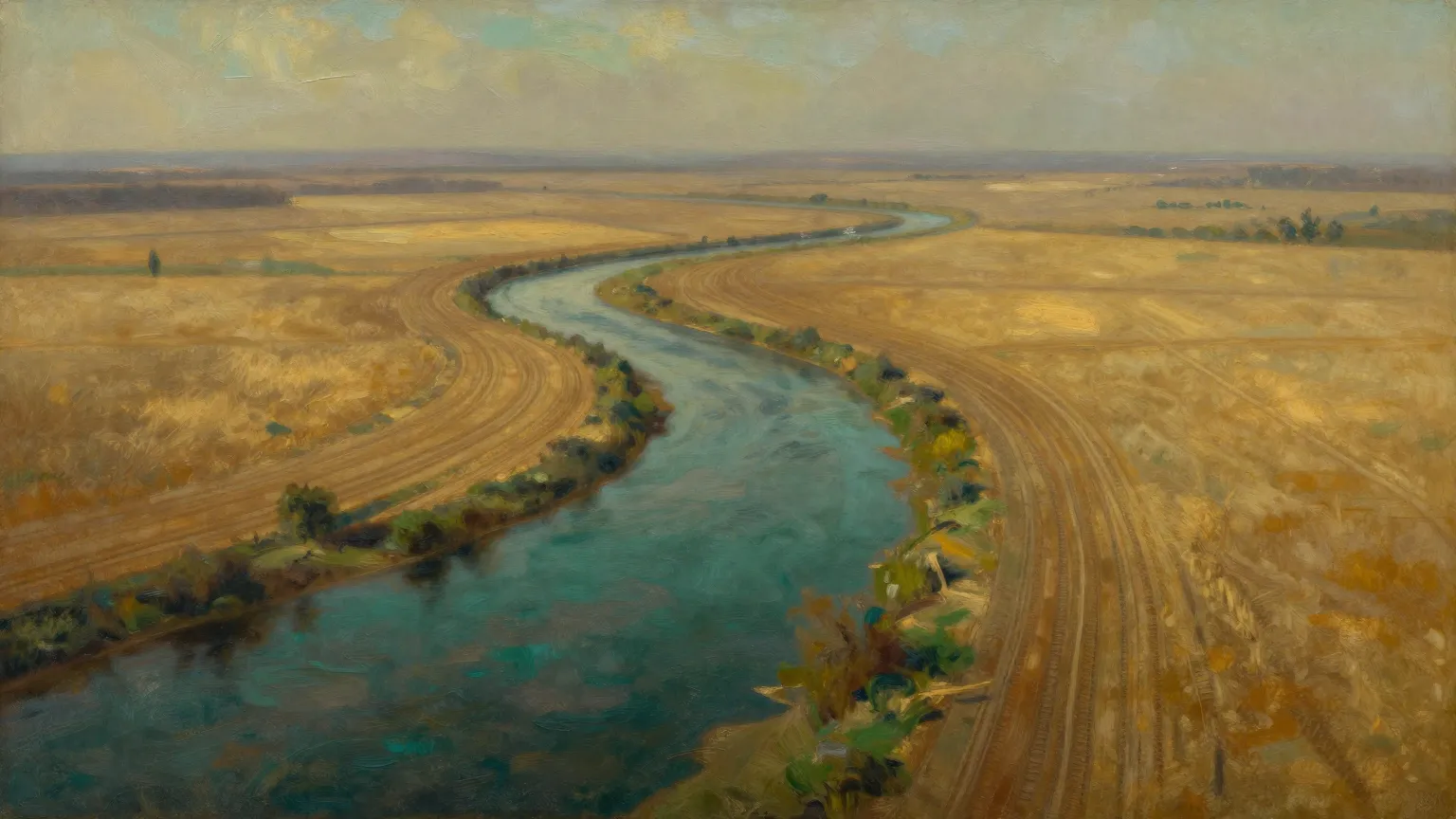
A note before we begin. Punjab in this letter means the historical land of the five rivers, most of which lies today in Pakistan, unless the modern Indian state is named. Even the name is younger than the farming: Panj-ab, five waters, is a Persian compound, a translation of the older Sanskrit pancanada, and it became the region's everyday name only in the Mughal centuries. The rivers were being farmed for thousands of years before anyone thought to count them in Persian. This is a long letter, the longest the house will ever send, because the house is built on this ground and owes it a proper accounting. Pour something and take your time.
The Land Before the Name
Begin with what the land is. Five rivers come down from the mountains, the Jhelum, the Chenab, the Ravi, the Beas and the Sutlej, and between each pair lies a tongue of land the Persian clerks would one day call a doab, land of two waters: Sindh Sagar, Chaj, Rachna, Bari, Bist-Jalandhar, each named for the rivers that bracket it. The rivers laid down the soil itself, alluvium carried out of the Himalaya and spread across the plain, flood by flood, for longer than humans have existed. Rain falls unevenly across it, from roughly three hundred millimetres a year in the arid south-west to more than a thousand in the sub-Himalayan north-east, most of it arriving in the summer monsoon. Every farmer who has ever worked this plain, and every vine that will ever grow on it, lives inside that gradient.
The oldest farming yet excavated anywhere near these plains is not in Punjab at all. It is at Mehrgarh in Balochistan, at the mouth of the Bolan Pass, where around nine thousand years ago people were growing six-row barley and the early wheats, einkorn and emmer, and keeping sheep, goats and cattle, working with stone sickle blades and grinding stones at the gateway between the highlands and the plains. Whether those first farmers are the ancestors of the plain's later farmers is now genuinely doubted: recent work on ancient DNA suggests the crops travelled more reliably than the people did. The seeds moved east and north from village to village, and by about 3300 BCE there were farming settlers on the banks of an old course of the Ravi, at the place archaeologists call Harappa.
What rose there, and at its sister cities, was one of the world's first urban civilisations, and it was fed by a form of farming that should humble every modern irrigator: no canals, no dams, no lifted water. The river did the work. Wheat and barley went into the wet ground in November as the floodwaters pulled back, and were cut in April before the waters returned. Peas, lentils, sesame and mustard grew alongside; in the summer season, dates and cotton. The cotton matters: Gossypium arboreum was domesticated in the Indus region independently of anywhere else on earth, which makes this plain one of humanity's first cotton countries, spinning thread five thousand years ago. At Harappa a great twelve-unit brick structure stood on a raised podium beside circular brick working floors where grain was pounded and threshed; it was long read as a granary, though its true function is now disputed. And at Kalibangan, to the south-east on the dried Ghaggar course in present-day Rajasthan, excavators found the earliest known ploughed field on earth, from around 2800 BCE: a criss-cross grid of furrows, one set about thirty centimetres apart, the other about a hundred and ninety. Farmers in that same tract still plough to almost exactly those spacings today, a cereal in the close rows, a pulse in the wide ones. The oldest field we have looks like a working one.
The cities declined from around 1900 BCE, over centuries, for reasons no serious scholar reduces to a single cause. This is the first honest lesson of the deep past: the story of this land is continuity of place, not continuity of people. Societies rose, farmed brilliantly, and dispersed; long gaps followed; new people sowed the same crops in the same soil. The Rigveda, composed somewhere in this river country in roughly the second millennium BCE, remembers the rivers rather than the fields: its great river hymn calls the roll of the Sindhu with the Vitasta, the Asikni, the Parusni, the Vipas and the Sutudri, the ancient names of the five, and its idea of wealth is cattle. Settled grain farming moves to the centre of the record only in the later Vedic layers. The plain kept its own count, in furrows.
Lahore Becomes a Capital, 1000 to 1526
Around the year 1000 the plain enters the millennium this letter promised, and it enters it already old. In 1021 Lahore stopped being the far edge of somebody else's empire and became the Indian capital of one: Mahmud of Ghazni took the city, installed his trusted commander Malik Ayaz to govern it, and for more than a century and a half Lahore was the Ghaznavid dynasty's principal Indian centre, becoming its actual capital in the 1160s when Ghazni itself was lost. When the Delhi Sultanate's conventional history begins in 1206, it begins in Punjab: Qutb al-Din Aibak ruled from Lahore and died there in 1210, and only under his successor did Delhi become the seat. Punjab was the centre; Delhi was the acquisition.
What did empire mean to a farmer? Chiefly, it meant the revenue system. The sultans paid their officers not in coin but in the iqta: the right to collect the land revenue of a district, a salary drawn on a landscape. It was not ownership of land, and the historians who know the period best insist on the distinction; the sultan could move a man from one district to another, and did. The demand itself was graded with a sophistication that surprises people who imagine the medieval countryside as unmanaged: crops that needed lifted water, wheat and sugarcane, were assessed above the hardy rain-fed millets and gram. When the traveller Ibn Battuta crossed this country in the 1330s he recorded a countryside producing two harvests a year and counted the types: seven distinct autumn-sown crops, four spring-sown. That granularity, from a named eyewitness seven centuries ago, is the medieval Punjab a farmer would recognise: the same two-season rhythm, harhi and sauni, rabi and kharif, that governs the plain to this day.
The same decade shows the system's teeth. From the mid-1330s into the early 1340s, failed monsoons and a raised revenue demand together drove a famine across the Doab and Delhi's hinterland severe enough that chroniclers describe whole villages abandoned for the jungle rather than pay. No usable death toll survives. It is the first well-recorded instance of a pattern this letter will meet again: on this plain, the harvest and the state have never been separable.
Two innovations of these centuries deserve their names. The first is the geared well-wheel, which Punjabis call the halt or rahat; "Persian wheel" is a European label. A garland of clay pots on a rope loop, hung over a wheel, driven through a pin-drum gear so that one bullock, walking a circle, lifts water continuously from a deep well. Pot-garland wheels without gearing appear in Indian sculpture as early as the sixth century; the gearing, which is the revolution, is attested in Punjab from around the thirteenth to fourteenth century. It did not transform the whole plain, and honesty requires saying so: it served the doabs, where the water table sat close enough for a bullock's patience to reach it. Everywhere else, farming still waited on the sky or the river. The second innovation is state canal-building. In 1355 Sultan Firuz Shah Tughlaq began cutting canals from the Yamuna and the Sutlej to water his new city of Hisar-i-Firoza, on the order of a hundred miles across several channels, naming one for his father and one for his cousin, the works recorded by the contemporary chronicler Shams-i Siraj Afif. Dynastic pride, written in water. Punjab would see a great deal more of that.
The Mughal Measure, 1526 to About 1750
On 21 April 1526, at Panipat on the plain's eastern edge, Babur defeated Ibrahim Lodi and the Mughal age began. Babur was a conqueror with an engineer's eye, and in the memoir he wrote in his last years he paused, amid dynasties and gardens, to describe exactly how water was lifted from wells at Lahore and Dipalpur: two ropes looped to the size of the well, wooden stakes lashed across them, jars tied to the stakes, the whole garland turned over a wheel. He also recorded, without romance, that most of Hindustan's farming needed neither watercourse nor dam: it ran on rain. Both observations were correct, and together they describe Punjab's agriculture for the next three centuries.
The Mughal contribution was less the canal than the measure. Around 1580, Akbar's finance minister Raja Todar Mal instituted the settlement known as the dahsala, the ten-year system: for each crop in each locality, yields and prices were averaged over the previous decade, and the state's demand was fixed at roughly one-third of that average produce, payable in cash. Land itself was classified by its cultivation history, and the vocabulary tells you how closely the clerks were watching: polaj, worked every year; parauti, recently rested; chachar, rested three or four years; banjar, rested five or more. An empire that tracked the rest cycles of individual fields. The great gazetteer of the reign, the Ain-i-Akbari, compiled in the 1590s, set out Punjab's districts in ordered tables; it must be read for what it is, a register of assessed revenue demand rather than of output or population, but as a portrait of administrative ambition it has few equals anywhere in the early modern world.
The canals returned under Shah Jahan. After 1639, when the Persian engineer-noble Ali Mardan Khan became viceroy in Punjab, a channel was cut from the Ravi at Madhopur and run roughly a hundred miles to Lahore, the hydrology executed by Mulla Ala'ul-Mulk Tuni, completed in 1644. Its most celebrated duty was to feed the Shalimar Gardens, whose foundation was laid in June 1641: hydraulic engineering and imperial pleasure on a single alignment. Remember the name Madhopur and that channel, the Shah Nahr, later called the Hasli. This story is not finished with it.
Was Mughal Punjab an agrarian golden age? The scholars disagree, and the disagreement is worth a sentence each. Irfan Habib's reading is that the demand pressed so close to the maximum extractable surplus that peasants fled the land, and that the empire's countryside was in crisis by the later seventeenth century. A later generation of historians reads the same evidence as regional commercial dynamism slipping out of imperial control. Both agree on the machinery's formidable reach, and a farmer might observe that both descriptions, extraction and dynamism, are usually true of Punjab at once.
The Khalsa Countryside, 1748 to 1849
As Mughal authority collapsed, the Sikh misls rose from the 1740s, and the countryside learned a new fiscal vocabulary: rakhi, a fifth of a village's revenue, collected twice a year, timed to the two harvests, in return for keeping other armed men away. Sikh tradition calls it protection; Mughal officials called it something less flattering; it was the standard currency of a collapsing empire's countryside, and its calendar was the cropping calendar. These were also years of terrible cost. In February 1762, near Kup by Malerkotla, Ahmad Shah Durrani's forces killed great numbers of Sikhs, many of them non-combatant families on the move, a catastrophe remembered as the Wadda Ghallughara. The house records it plainly and moves on with respect, as Punjab itself had to.
Ranjit Singh took Lahore in 1799 and was proclaimed Maharaja in 1801, and until his death in 1839 the five rivers had, for the first time in centuries, a single sovereign of their own soil. His state lived on the land revenue, taken as a share of the crop, between roughly a fifth and a half depending on soil, district and the man in between; from the 1820s his officials increasingly valued the standing crop before harvest rather than dividing it on the threshing floor. Whether the burden felt heavy or light depended almost entirely on that man in between, the jagirdar, and a large share of the kingdom's revenue, plausibly approaching two-fifths, was assigned to such men rather than reaching Lahore. It was a conquest state financed by the harvest, like its neighbours; it was also a state that minded the water. His engineers found Shah Jahan's Hasli canal derelict and rebuilt it, adding a branch toward Amritsar and the young Golden Temple's city.
And for the first time, Punjab's fields were described by outsiders who wrote everything down. William Moorcroft, an East India Company veterinary surgeon chasing horses and trade routes, crossed the plain in May 1820 and left manuscripts running to some ten thousand pages. The French naturalist Victor Jacquemont reached Lahore in March 1831, met the Maharaja, and recorded a one-eyed ruler with "an attractive face" and excellent teeth, along with the observation that Ludhiana, a town of twenty thousand, had built a Kashmir-shawl industry from nothing in twenty years. Baron von Hügel followed in 1835. Through their pages we glimpse what the Khalsa countryside sounded like: the creak of the rahat, a bullock walking its circle, pots rising out of a well. Villages rich enough to run two wheels on one well had a special name for it. That sound, more than any battle, was Punjab.
The Engineered Province, 1849 to 1947
The British annexed Punjab in 1849, and within a decade began the largest transformation of farmland the world had then seen. They started, tellingly, on the old alignment: the Upper Bari Doab Canal, opened in 1859, took off from the Ravi at Madhopur, where Ali Mardan Khan's channel had run and Ranjit Singh's engineers had rebuilt it. Mughal to Sikh to British on one headworks: in Punjab even the revolutions are continuous.
Then came the colonies. Between the 1880s and the 1940s, nine canal colonies were driven into the dry bar country of the western doabs: Sidhnai and Sohag Para first, then the great Chenab Colony from 1892, Chunian, Jhelum, Lower Bari Doab, Upper Chenab, Upper Jhelum, Nili Bar. Punjab's canal-irrigated area rose from about three million acres in 1885 to about fourteen million by 1947, most of it in these tracts. Settler families from the crowded eastern districts, Ludhiana, Hoshiarpur, Ambala, travelled west with cattle and seed to take up allotments laid out in geometric squares, the murabba, twenty-five acres in the standard Punjab measure, a little larger in the Lower Chenab. The colony capital was planned in the 1890s and named Lyallpur for the Lieutenant-Governor; its centre was laid out in the shape of the Union Jack, eight bazaars radiating from a clock tower visible down every one of them. Empire built its self-portrait into the street grid of a farm town. Since 1977 the city has been called Faisalabad, and it lies, like almost the whole colony landscape, in Pakistan.
Honesty about what this was: not simply an agricultural development project. The historian Imran Ali showed that the colonies were as much political and military instruments as agrarian ones, rewarding the loyal, cultivating a landed gentry, and in the Jhelum Colony explicitly conditioning grants on breeding horses and mules for the army. The land the administration called waste was not empty; it was the grazing country of pastoralists the officials labelled Janglis, and calling it Crown waste was the legal act that made it available to give away. They protested, and were granted a small fraction of the colony land, on the worst of it. And a third of rural Punjab appears nowhere in the allotment registers at all: the agricultural labourers, overwhelmingly Dalit, who dug the channels and picked the cotton and were allotted nothing, because every scheme of this era, and of the eras before and after it, gave land to those who already held land. Any honest history of Punjabi farming carries that absence all the way through.
The railways turned the new harvest into a world commodity. A line from Karachi opened in 1861, Lahore and Amritsar were joined in 1862, and the through route from Karachi to Lahore was complete by 1878: a journey of roughly forty days by road became about forty-eight hours, and wheat that had once rotted in bumper years now moved to ports and on to Britain. By 1910 Karachi shipped more wheat than any other port in the British Empire; by the 1920s Punjab was growing about a third of British India's wheat on a fraction of its land. The province had become the empire's principal wheat-surplus engine, and the world had learned to eat from the five rivers.
The countryside paid for the miracle twice. First in debt: the moneylender travelled with the canal, and the Punjab Alienation of Land Act of 1900, presented as the peasant's shield, in fact invented a legal category, the agricultural tribes, locked land transfers inside it, and pushed lending into new hands without lowering the burden; a colonial administrative category slowly hardened into an identity worth claiming. The settlement officer Malcolm Darling, whose 1925 study of the Punjab peasant remains the era's most quoted document, found debt rising with prosperity, not falling; he blamed weddings and custom, because a settlement officer could not easily see the revenue demand and the credit monopoly behind his own desk. Second in salt: within forty years the canals had lifted the water table under the irrigated tracts far enough to waterlog and salinise land they had made famous, and drainage boards were at work by the 1920s. Every irrigation system is a loan from the water table. Punjab has been discovering the interest rate for a century.
Once in this era, the farmers won outright, and the story deserves its full dates. In 1906 and 1907 the administration moved to tighten colony tenures and raise water rates by a quarter. On 22 March 1907 at Lyallpur, a newspaper editor named Banke Dayal recited a poem to a protest meeting: Pagri Sambhal Jatta, mind your turban, farmer, and the phrase became the movement. Its leader was Sardar Ajit Singh, uncle of Bhagat Singh; he addressed nineteen of the campaign's thirty-three great meetings, and on 9 May 1907 he and Lala Lajpat Rai were deported to Mandalay. Before the month was out the Colonisation Bill was refused assent and the rate rise dropped; both men were released on 11 November. It remains the cleanest victory Punjabi farmers ever won against an empire, and they won it with a poem, which is the most Punjabi possible way to win.
The Line, and What Was Rebuilt, 1947 to 1963
The Radcliffe Award, the line that divided Punjab between two new states, was completed in mid-August 1947 but published on 17 August, two days after independence. Punjab's farmers therefore harvested and fled across a border that legally existed before anyone was told where it ran. On the order of five million Muslims moved west; on the order of four million Hindus and Sikhs moved east; and the word migration flatters what happened, because people moved under massacre, with the military escorts following the violence rather than preventing it. How many died is genuinely unknown; published estimates run from two hundred thousand to two million, and no figure in that range is well founded. The house names this with care because its own family, like almost every Punjabi family, carries some piece of that August.
The line also cut the water. India held the headworks at Madhopur on the Ravi, that same Madhopur, and at Ferozepur on the Sutlej, while the great share of the acreage they fed lay in Pakistan; of the basin's irrigated land, on the order of four-fifths went west, while a handful of controlling headworks went east. A standstill agreement between the two chief engineers expired on 31 March 1948 with nothing agreed to replace it; on 1 April, East Punjab closed the regulators feeding the Upper Bari Doab and Dipalpur canals, days before Pakistani sowing. Pakistan has always read that as coercion; India as an agreement that had simply lapsed. Water flowed again after about five weeks under an inter-dominion agreement that May, and twelve years of negotiation later the Indus Waters Treaty of 19 September 1960 divided the rivers themselves: the Ravi, Beas and Sutlej to India, the Indus, Jhelum and Chenab to Pakistan. The five rivers, which had defined one country of the mind for a millennium, now defined two states' plumbing.
On the land, East Punjab then performed one of the great unsung administrative feats of the twentieth century. Refugee farmers arriving from the west claimed about 2.7 million hectares left behind; only about 1.7 million hectares of evacuee land existed to give them. An Indian Civil Service officer named Tarlok Singh, trained at the London School of Economics, met the shortfall with arithmetic. Land was converted into a synthetic unit, the standard acre, defined by yield, ten to eleven maunds of rice, roughly four hundred to four hundred and fifty kilograms, so that four poor dryland acres might equal one canal-fed acre; and a graded cut was applied to every claim, about a quarter off the smallest holdings, rising to as much as ninety-five percent off claims above five hundred acres. The greatest landlords absorbed the greatest losses. One widow whose husband had held some eleven and a half thousand acres across thirty-five villages in the west was resettled on eight hundred and thirty-five, in one village, in the east. A temporary bureaucracy of roughly seven thousand officials finalised nearly a quarter of a million allotments in about two years. It was harsh, progressive and fast, and it worked; and, once again, it allotted against prior title, so the labourers who had worked the abandoned fields received, once again, nothing.
Two more acts completed the rebuild. The consolidation law of 1948 began stitching each family's scattered fragments into single compact holdings, finishing a process the region had needed for centuries. And on the Sutlej, at Bhakra, the new republic built its cathedral. Nehru opened the Nangal canal system in July 1954, before the dam itself existed, calling such works the temples of new India; he poured the dam's first concrete in November 1955 and dedicated the finished structure, some two hundred and twenty-six metres of it, on 22 October 1963, telling the crowd it was "something tremendous, something stupendous". Its waters reach over ten million acres across four states. Down the road, Le Corbusier was building Chandigarh, Punjab's new capital, and took a direct interest in the dam: the two belong to one project, a modernist answer to an amputation.
The Seed, 1961 to 1985
The famous part of the story is usually told wrong, so let the record be set down carefully. The miracle seed did not rescue a backward province. It arrived in the most heavily engineered farmland in India: canals a lifetime old, holdings freshly consolidated, a new dam upstream, and a farming population with a thousand-year record of adopting first. Ludhiana was chosen for the Intensive Agricultural District Programme in 1961 precisely because it was already the most irrigated, most consolidated, most market-oriented district in the country. Punjab Agricultural University was founded at Ludhiana on 17 October 1962 on the American land-grant model, championed by Chief Minister Partap Singh Kairon and inaugurated by Nehru the following July. In March 1963 Norman Borlaug spent twenty-five days moving through the wheat tracts, sleeping in villages, looking at fields with his own eyes. That October, a parcel of roughly one hundred kilograms of seed, four Mexican semi-dwarf wheat varieties, reached Delhi for trials, Ludhiana included. Three years later India imported about eighteen thousand tonnes of it, the largest seed import any country had made. From one hundred kilograms to eighteen thousand tonnes: the whole era in one pair of numbers.
And then Punjab did what Punjab has always done with a new tool: improved it to local purpose. The imported grain was red, wrong for chapati flour and wrong for the Punjabi kitchen, so Indian breeders re-selected for amber and produced Kalyan Sona, the golden one, and Sonalika; the miracle seed had to pass a Punjabi kitchen before it could feed Punjab. Around the seed the state assembled the rest of the machine: an Agricultural Prices Commission and a Food Corporation in 1965, and a guaranteed minimum price for wheat from the 1966 to 1967 season. What followed has few parallels in agricultural history. Between the mid-1960s and the mid-1980s, Punjab's wheat harvest rose roughly five-fold, from under two million tonnes to over ten. Rice, which had barely been a Punjab crop at all, under three hundred thousand hectares in 1966, rose more than fifteen-fold in output; Punjab as India's rice bowl is not an ancient identity but a construction of the last sixty years, built on the state's own bred-for-Punjab varieties as much as any imported miracle. Through the 1980s and 1990s this one state, on under two percent of India's land, was supplying between half and three-quarters of all the wheat and a third to a half of all the rice that India's central reserves procured. Whether the Green Revolution averted famine, or whether the threat of famine was partly a story told to justify it, is still argued among historians; what is not argued is that within a decade India stopped importing wheat, and that the fields which made that possible drink from the five rivers.
The Bill, 1985 to Now
Every harvest is an account, and the account has come due. Punjab's paddy area has grown from about two hundred and twenty-seven thousand hectares in 1960 to over three point two million today, roughly fourteen-fold, until rice and wheat together occupy some five-sixths of the state's cropped land. The water for it came from below: from under two hundred thousand tube wells in 1970 to on the order of one and a half million today. In the central groundwater assessment of 2025, Punjab was extracting at 156 percent of its annual recharge, the highest of any Indian state, with nearly three-quarters of its assessment blocks classed as over-exploited; projections suggest the first hundred metres of aquifer could be effectively exhausted around the end of this decade. And the cause is not the seed. It is the ledger: a guaranteed price for rice and wheat and for nothing else, a state agency that buys whatever is grown of both, and farm electricity free of charge since 1997, so that the marginal cost of pumping ancient water is zero. Punjab does not grow rice because rice belongs here. It grows rice because the incentives say so, and a thousand years of this history says Punjabi farmers respond to incentives faster than anyone. Change the incentive and the crop will change; the seed was never the variable.
There are honest signs of the turn. A state law now forbids transplanting paddy before mid-June, to spare the aquifer the driest weeks. The burning of rice stubble, measured by satellites passing overhead twice a day, has fallen steeply in recent years, though the scientists counting the fires caution that detection is not the same as burning. Most striking of all, the extraction figure has begun, just barely, to move the right way: down from 164 percent to 156 in two years, with dozens of blocks improving, and officials crediting one thing above all: farmers returning to canal water, over a hundred derelict channels restored, one canal in the Kandi tract flowing again after forty years. The oldest technology in this entire story, the cut channel that Firuz Shah's engineers would recognise, is what is buying the aquifer time. Meanwhile the people have been leaving: farming occupied a clear majority of Punjab's workers a generation ago and roughly a quarter now, and the sons and daughters of farming families have carried the inheritance abroad, to England and Canada and beyond, as one of them did in 1974. Some of them, it should be said, carried it into vineyards: Punjabi farming families have been growing wine grapes in British Columbia's Okanagan Valley for decades. Punjabi viticulture is not a novelty. It has simply been happening eleven thousand kilometres from Punjab.
The Vine
So what, in all honesty, has the vine to do with this land?
More than nothing, less than a tradition, and the house prefers the precise answer to the flattering one. Grape wine appears in Indian statecraft as early as the Arthashastra, which names varieties arriving from the north-west frontier, though those were almost certainly imports moving down the passes rather than wines of the plain. There were vines around Lahore in the Mughal centuries. In the 1930s the agricultural college at Lyallpur trialled over a hundred table-grape varieties; that college and its vines have been in Pakistan since 1947. And in 1962, the very year Kairon founded the agricultural university, his government brought the Anab-e-Shahi grape north from Hyderabad and imported a hundred thousand cuttings of Perlette, appointing a Grape Extension Adviser named B.M. Pansare to spread them. Punjab has grown grapes before, for the table, twice in the last century. It has never grown wine. No vineyard on this plain has ever been planted, tended and harvested for the sole purpose of the cellar: the heat at ripening, the monsoon sitting on the harvest, and the absence of any wine tradition saw to that. That is the gap in the record, stated exactly, and it is into that gap that this house is planting.
The house makes the claim carefully, because this letter has earned the right to be believed: Pal Vineyards is Punjab's first dedicated fine-wine vineyard. Not the first grapes; the first wine. And the reader who has followed the thousand years will understand why the house believes the land is ready for it. Every quality fine wine demands, this history has already demonstrated: hand cultivation as a norm rather than a boast, water discipline learned over centuries of wheels and channels and now being relearned the hard way, the two-season patience of rabi and kharif, and above all the habit, repeated in every era from the first furrows at Kalibangan to the amber re-selection of a Mexican seed, of taking a new thing and mastering it faster than anyone thought possible. A vine asks nothing of Punjab that Punjab has not already given something else. One more note, given plainly because this letter goes to Punjabi households of every kind: the house knows that for initiated Sikhs the Rehat Maryada forbids intoxicants, and it makes its wine with respect for those who will never drink it, as one more work of the same soil, offered to those who choose it.
The house's founder is the son of one of the leavers. Pal Singh was born in 1955 in Tarn Taran, in Majha, to a farming family on its ancestral land; he left for England in 1974, learned a craft, cooked, built, and died in 2017 having done everything properly. His son is planting a vineyard in the country his father came from, and has put his father's name on it. After a thousand recorded years of wheat, cotton, cane, rice, of empires fed and granaries filled, of canals cut and wells sung over, the land of five rivers is being asked, for the first time, to make something purely for joy. The house believes the land, of all lands, has earned that.
The first release, from the Malwa lands south of the Sutlej, opens by allocation in February 2027. Allocation requests are reviewed as they arrive. To join the list, write to the house or visit palvineyards.com/allocation.
Lavjit Sra, Pal Vineyards
Pal Vineyards is planting the first fine wine grown in Punjab, in tribute to his late father, Pal Singh.
Further Reading
Irfan Habib, The Agrarian System of Mughal India. Shireen Moosvi, The Economy of the Mughal Empire c.1595. Indu Banga, Agrarian System of the Sikhs. Imran Ali, The Punjab Under Imperialism, 1885 to 1947. Neeladri Bhattacharya, The Great Agrarian Conquest. Malcolm Darling, The Punjab Peasant in Prosperity and Debt. Daniel Haines, Rivers Divided, and David Gilmartin, Blood and Water, on the division of the rivers. Nick Cullather, The Hungry World, on the Green Revolution's politics. Jamison and Brereton's Oxford translation of the Rigveda. The Baburnama, in any edition, for the well-wheel passage alone. And the Central Ground Water Board's annual assessments, for the account still being written.