
Grapes for Hot and Humid Climates: What the Research Says
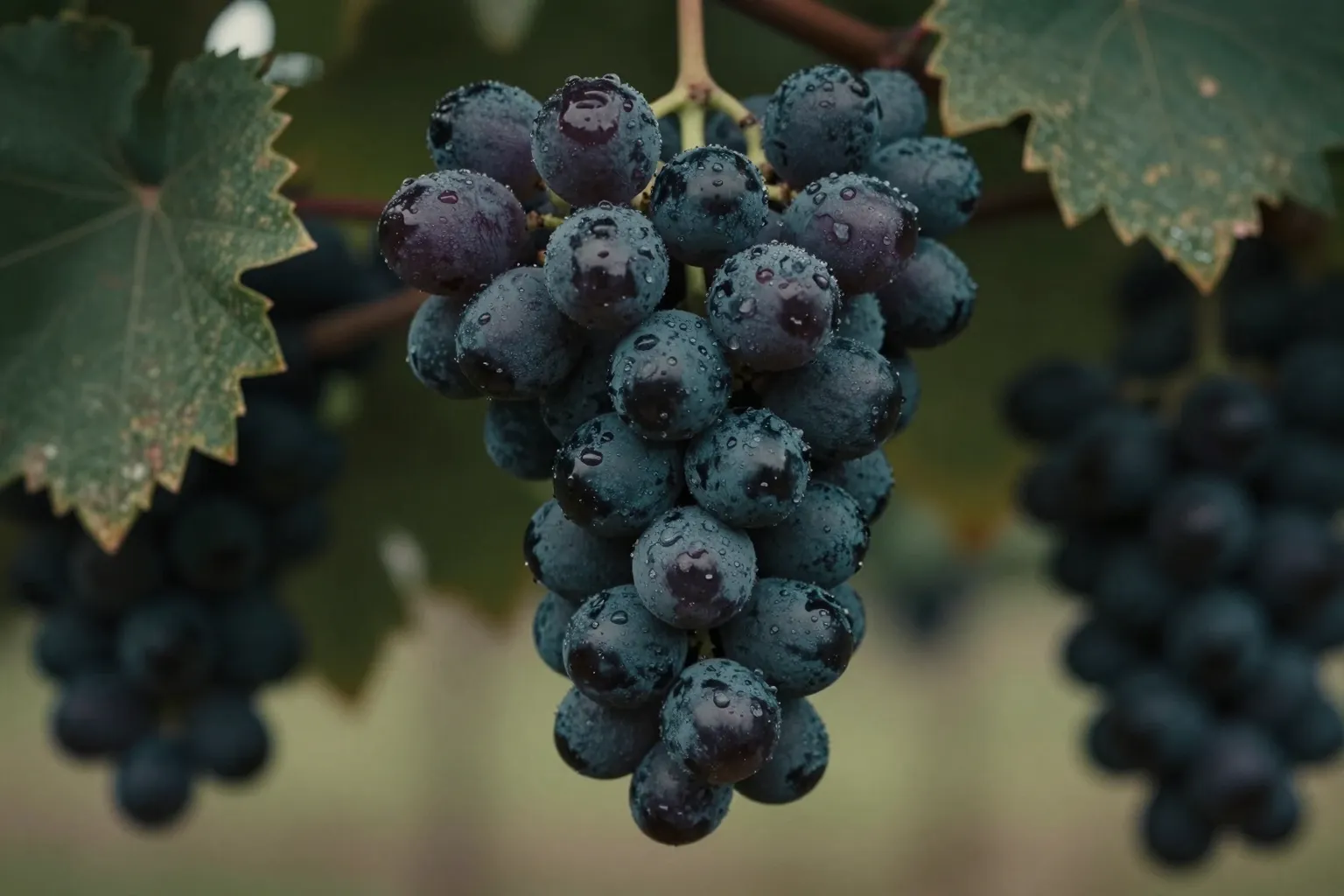
Wine grapes were domesticated for temperate, seasonally dry climates. Grow them where it is hot and the air stays wet for months and two problems arrive together: heat that compresses ripening, and humidity that feeds fungal disease. This article sets out what published research says about both, and where that research runs out. It is general background on viticulture, not a statement about what any particular vineyard grows.
Two problems, not one
Heat and humidity act on the vine in different ways, and a variety or technique that helps with one can do nothing for the other.
The root of the disease problem is botanical. Classic wine varieties belong to one species, Vitis vinifera. Reviews of the breeding literature note that it has almost no native resistance to downy and powdery mildew, two diseases that came from North America, which is why conventional vineyards spray so often. Wild vines from North America and Asia, and a related genus, Muscadinia, do carry resistance, and breeders have spent decades crossing it into wine-quality plants.
How India’s grape climates differ
India is a useful test case because it contains several grape climates. It grows a great deal of grapes and very little wine grape: according to ICAR-NRC Grapes, roughly 77 to 78 per cent of the crop is table grapes and about 20 per cent raisins, leaving juice and wine with only a few per cent between them. Maharashtra and Karnataka alone hold about 94 per cent of the national grape area (ICAR-NRCG, 2022 to 23 state table).
The institute and related horticultural sources describe three zones. In the tropical zone (Maharashtra, Karnataka, Andhra Pradesh, Tamil Nadu) growers prune twice, take a single quality crop in the dry winter, and contend with salinity, drought and monsoon disease. In the sub-tropical north (roughly 28 to 32°N, taking in Punjab, Haryana, Rajasthan, western Uttar Pradesh and Delhi) vines go dormant, are pruned once in December or January and give one early-summer crop. Only about 90 to 95 days separate budburst from the monsoon there, and only an early table variety, Perlette, reliably beats the rains.
The signature response in the tropical zone is double pruning. A foundation prune after the summer harvest, roughly March to May, grows the canes. A fruit prune in October or November sets the crop, which ripens in the dry months of January to March. In effect the vine is taught to ripen when the rain has stopped, which is a management answer to humidity rather than a genetic one.
Rootstocks and varieties bred for stress
Rootstocks are the quieter half of the story. ICAR-NRCG trials have compared the vigorous Dogridge with 110R and 1103 Paulsen. Dogridge is valued for drought and nematode tolerance, but in the institute’s work it accumulated the most sodium and performed poorly on lime. 110R and 1103 Paulsen balanced quality and fruitfulness better and are the rootstocks the evidence most often supports on saline or alkaline soils.
India’s own breeders have also released a stress-adapted vine. Manjari Medika, released by ICAR-NRCG in 2018, is a dark-juiced (teinturier) variety from Pusa Navrang and Flame Seedless that needs about 130 days from pruning and is reported to be far more disease-resistant than comparable table and wine grapes.
Among conventional wine grapes planted in India, industry and trade sources suggest Chenin Blanc has been the most successful. By volume, Sauvignon Blanc, Chenin Blanc, Cabernet Sauvignon and Shiraz dominate. Those are market observations, not trial results.
What warming does to the map
The wider climate literature frames hot-climate viticulture as a moving target. A 2013 study in PNAS by Hannah and colleagues, using a 17-model ensemble under a high-emissions scenario, projected that by 2041 to 2060 the suitable area for wine would fall by 68 per cent in Mediterranean Europe, 60 per cent in California and 73 per cent in Mediterranean Australia, while rising sharply in cool frontiers such as Northern Europe (99 per cent) and New Zealand (168 per cent). A 2024 synthesis in Nature Reviews Earth & Environment by van Leeuwen and colleagues concluded that about 70 per cent of today’s wine regions could become unsuitable above roughly 2°C of warming.
The same synthesis is candid about the limits of the remedies. Changing plant material and delaying ripening work, in its words, “until a certain level of warming”. Altitude helps but offsets less than about 20 per cent of the Mediterranean losses, and only up to around 1,000 metres. Summaries of this research point to late-ripening, heat- and drought-tolerant cultivars on drought-tolerant rootstocks, among them Syrah, Grenache, Mourvèdre, Assyrtiko, Xinomavro, Touriga Nacional and Tempranillo. That is a medium-reliability reading of the literature, not the output of any Indian trial.
PIWI vines: what they are
For humidity, the most researched answer is the PIWI vine. The name comes from the German Pilzwiderstandsfähig, fungus-resistant. These are wine grapes made by conventional crossing of V. vinifera with resistant wild vines, with marker-assisted selection used only to choose which seedlings to keep. They are not genetically modified or gene-edited (PIWI International). Resistance comes from named loci with labels such as Rpv3.1 or Rpv10, and breeders increasingly stack several of them, a practice called pyramiding.
The spray evidence is substantial. In a German study published in 2023 (Eisenmann and colleagues), a susceptible vinifera needed about 14 plant-protection treatments in the high-pressure 2021 season. Cabernet Blanc and Satin Noir needed 2 to 4, Calardis Blanc 2, and Muscaris and Sauvignac none. Across the varieties studied, resistant cultivars cut plant-protection treatments by 60 to 90 per cent and applied copper and sulphur by 52 to 79 per cent, with no loss of grape or plant health. A 2025 European review (Trapp and colleagues) puts the overall reduction in fungicide input at roughly 50 to 80 per cent, though the exact headline figure could not be checked against the paywalled text, so read it as a range.
The same Eisenmann study found that omitting treatments entirely caused mildew infection and losses in yield and quality. PIWIs reduce spraying; they do not abolish it.
Resistance does not last forever
The downy mildew pathogen, Plasmopara viticola, adapts. Rpv3.1, the most widely planted locus, was first overcome in 2010 on the variety Bianca, with no fitness cost to the virulent strain (Peressotti and colleagues). A 2022 survey of European strains found breakdown of Rpv3 widespread and the first breakdowns of Rpv10 and Rpv12 (Paineau and colleagues).
The more recent news is harder. In 2024, at three vineyards within about 40 kilometres of each other in south-eastern France, all planted to the variety Artaban, which stacks Rpv1 and Rpv3.1, 19 of 21 tested strains overcame Rpv3.1, ten overcame Rpv1, and four genetically distinct strains overcame the whole pyramid. The authors described the Rpv1 cases as the first documented breakdown of that locus in Europe (Pelissier and colleagues, 2025). A separate 2026 paper reported strains from Cilaos on Réunion Island, collected in 2023, that overcame Rpv1, Rpv3.1 and Rpv10 at once, the first strain known to defeat three loci (Ramírez Martínez and colleagues). A 2026 bioRxiv preprint, not yet peer reviewed, argues that pyramids still protected vines under heavy epidemic pressure; it is a signal, not a finding.
Taken together, the research reads as durable but erodable. Pyramiding delays breakdown and monitoring pathogen populations matters, but no current PIWI is a permanent fix.
Warm and humid evidence, and its limits
The best warm-humid proof of concept comes from highland southern Brazil, in Santa Catarina, where downy mildew is the dominant disease. The white PIWI varieties Felicia and Calardis Blanc were productive and well adapted at two altitudes, 830 metres at Videira and 1,100 metres at São Joaquim, under minimal fungicide. These are mid-altitude highland sites, not hot lowland plains.
That is the central gap. As of June 2026, a search of ICAR-NRC Grapes and Punjab Agricultural University material found no published field trial of PIWI wine grapes anywhere in India, hill or plain. Nor is there data on how PIWIs behave under extreme heat, alkaline or saline alluvial soils, or the short, monsoon-bracketed ripening window of the north. It is also unknown which resistance loci would work against Indian strains of the pathogen, since their virulence has not been characterised. Equally, no published trial of wine varieties on the Punjab plains was located.
Two practical points complete the picture. First, grapevine planting material can legally be imported into India under the Plant Quarantine (Regulation of Import into India) Order, 2003, but it needs a phytosanitary certificate, additional declarations, advance permission and about a year in post-entry quarantine, with ICAR-NBPGR the designated authority. The live schedule was not re-read, so treat the process as slow and permit-heavy. Second, PIWIs come from conventional breeding, so organic standards that bar genetic engineering do not exclude them, though no Indian ruling on PIWI varieties was found.
What the evidence supports
For hot, humid climates the research supports three modest conclusions. Management that moves ripening away from the rains, such as double pruning, is proven at scale in India’s tropical zone. Rootstock choice matters and is better evidenced than variety choice. And fungus-resistant varieties can cut spraying by a large margin, but with eroding resistance, no Indian trial and a slow import route, they remain promising rather than proven for the plains.
Pal Vineyards publishes this as background reading for the curious, alongside its notes on Punjab and the land. It says nothing about what any vineyard, including ours, grows.
Sources
- Eisenmann B. et al., “Fungicide-Saving Potential and Economic Advantages of Fungus-Resistant Grapevine Cultivars”, Plants (Basel) 12(17):3120, 2023. https://doi.org/10.3390/plants12173120
- Trapp et al., “More sustainability in Europe’s vineyards: Using resistant grapevine varieties to reduce the input of pesticides”, Plants, People, Planet 7(6):1621 to 1628, 2025. https://doi.org/10.1002/ppp3.70038
- Peressotti E. et al., first Plasmopara viticola isolate overcoming Rpv3.1, BMC Plant Biology 10:147, 2010. https://doi.org/10.1186/1471-2229-10-147
- Paineau M. et al., pathotyping of European P. viticola strains (Rpv3, Rpv10 and Rpv12 breakdown), Phytopathology 112(11):2329 to 2340, 2022. https://doi.org/10.1094/PHYTO-11-21-0458-R
- Pelissier R. et al., “Multiple geographic breakdown events of the Rpv1-Rpv3.1 pyramided resistance in grapevine by Plasmopara viticola”, Plant Disease, 2025. https://doi.org/10.1094/PDIS-09-25-1881-RE
- Ramírez Martínez J. et al., “Multivirulent Plasmopara viticola strains from Cilaos on Réunion Island break down Rpv1, Rpv3.1 and Rpv10 mediated resistance of grapevine”, BMC Plant Biology, 2026. https://doi.org/10.1186/s12870-026-09004-9
- “Performance of resistant varieties (PIWI) at two altitudes in Southern Brazil”, BIO Web of Conferences 12 (2019) 01021. https://doi.org/10.1051/bioconf/20191201021
- “Response of PIWI grapevine cultivars to downy mildew in highland region of southern Brazil”, European Journal of Plant Pathology, 2019. https://doi.org/10.1007/s10658-019-01725-y
- “Pyramided resistance ensures grapevine (Vitis spp.) protection during high downy-mildew epidemic pressure”, bioRxiv preprint, 2026, not peer reviewed. https://www.biorxiv.org/content/10.64898/2026.02.11.705294v1
- PIWI International, definition of fungus-resistant (PIWI) varieties. https://piwi-international.org/en/about-piwi/what-are-piwi-wines/
- Plant Quarantine (Regulation of Import into India) Order, 2003. https://indiankanoon.org/doc/166301049/; ICAR-NBPGR, Division of Plant Quarantine. https://nbpgr.org.in/nbpgr2023/plant-quarantine-3/
- ICAR-National Research Centre for Grapes, Pune: state-wise grape area and production, 2022 to 23 https://www.nrcgrapes.in/State-wise-grape-area-and-production%2026.09.2024.htm; technical bulletin on Manjari Medika https://www.nrcgrapes.in/technical%20bulletins/e-techbul-1-manjari-medika.pdf.
- National Horticulture Board, grape cultivation (pruning and cropping) https://nhb.gov.in/pdf/fruits/grape/gra005.pdf; “Grapevine double cropping”, Frontiers in Plant Science (PMC10140338) https://pmc.ncbi.nlm.nih.gov/articles/PMC10140338/
- Hannah L. et al., 2013, Proceedings of the National Academy of Sciences (climate change and wine-growing area); van Leeuwen C. et al., 2024, Nature Reviews Earth & Environment. Both as summarised in the Pal Vineyards research file “Climate Change & the Future of Winegrowing (NW India)”, updated 22 September 2026. No link recorded.
- ISHS material on Indian viticulture and ICAR-NRCG climate-zone material; WSET India; Csizmadia-Honigh, The Wines of India. Compiled in the Pal Vineyards research file “Indian Grapes & Wine Industry”, updated 11 June 2026 and fact-checked 30 June 2026. No link recorded.
- Frontiers in Plant Science, 2017 (RUN1/REN1 pyramiding); BMC Plant Biology, 2019 (Rpv3 and Rpv1 loci). Compiled in the Pal Vineyards research file “Grapevine Genetics & Breeding”, updated 17 August 2026. No link recorded.